
Moving Tips
What Diplomats Can Teach Us About Moving, Living and Working Across Borders
What can diplomats teach us about moving abroad? Drawing on a conversation with Rahul Shrivastava, this article explores adaptation, family, crisis, loss and the meaning of home for people living and working across borders.
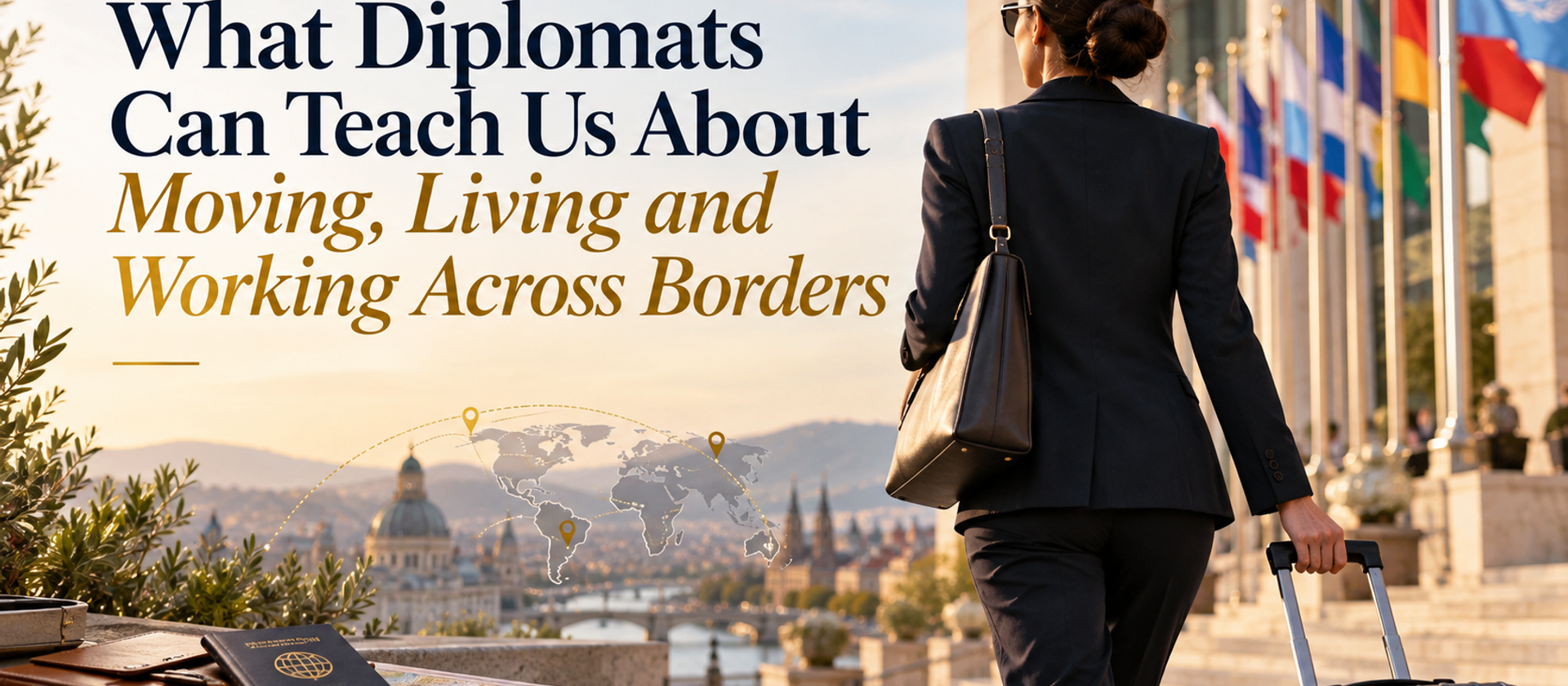
Six lessons from Rahul Shrivastava on adaptation, family, crisis and the meaning of home
After six international assignments, Rahul Shrivastava knows something many people learn only after several moves: going abroad is not simply about changing countries. It is about learning how to belong, adapt and keep moving.
International relocation is often presented as a logistical exercise:
- Find the right visa.
- Book a flight.
- Ship your belongings.
- Find somewhere to live.
- Open a bank account.
- Start your new life.
All of those steps matter. But anyone who has lived abroad knows that the hardest parts of moving between countries rarely appear on a checklist.
There is the emotional cost of leaving, the exhaustion of learning a new system, the challenge of building relationships from scratch and the responsibility of helping your family adapt. Sometimes circumstances change so dramatically that a carefully planned relocation becomes something else entirely.
Few people understand this better than diplomats.
In an episode of Go Borderless, I spoke with Rahul Shrivastava, an Indian diplomat whose career included six foreign assignments across four continents. His postings included Moscow, Caracas, Bucharest and Windhoek, giving him decades of experience living and working far from home.
What interested me was not only the diplomatic side of his career. It was what his experience reveals about the reality of living between nations.
Most of us may move internationally once, twice or a handful of times. Diplomats build an entire life around transition. Their experience offers useful lessons for anyone planning an international move—or trying to build a life abroad.
1. Moving abroad is not the same as arriving
One of the most interesting themes from our conversation was the emotional weight of constantly moving.
For many people, an international relocation has a clear beginning and end. You decide to leave, prepare, move and eventually feel settled. For diplomats and other globally mobile professionals, the cycle can be different. Just as one country begins to feel like home, another assignment appears.
Then you start again:
- A new country.
- A new home.
- A new school.
- New colleagues.
- New bureaucracy.
- New social circles.
- New routines.
- Eventually, another departure.
The practical skills required for moving may become almost second nature. Emotionally, however, that does not necessarily make the process easier.
There is a contradiction at the heart of international mobility: the better you become at leaving, the more clearly you understand what you are leaving behind.
That is why “arrival” deserves as much attention as departure. A successful move is not complete when your shipment reaches its destination. It is complete when you have begun to establish routines, relationships and a sense of direction.
2. Adaptability is the hidden relocation skill
We often discuss international mobility as though planning were the most important skill. Planning matters, but the longer you live abroad, the more you realise that adaptability may matter just as much.
Every country has its own systems and expectations:
- How homes are rented.
- How people interact with government offices.
- How appointments are made.
- How business relationships develop.
- How directly people communicate.
- How families socialise.
- What counts as punctual.
- What is considered polite or intrusive.
- What happens when something goes wrong.
Many of these rules are not written down. You learn them by observing, asking questions and paying attention to how people around you behave.
Diplomats are, in effect, professional adapters. They must enter unfamiliar environments, understand them quickly and maintain their own identity and responsibilities at the same time.
Every expat eventually develops this skill. The practical question is how quickly—and how deliberately—you choose to develop it.
A useful mindset is to treat your first months abroad as an observation period rather than a test you must immediately pass. Notice how systems work before assuming they should work the way they did at home.
3. Your family is relocating too
One aspect of Rahul’s story that particularly resonated with me was the distinction between moving yourself and moving your family.
An international move is not experienced by one person in isolation. A spouse may be leaving a career. Children may be leaving friends and schools. Parents may be staying behind. Pets have to be transported. Family routines disappear. Everyone experiences the same move differently.
The person who accepted an overseas assignment may be excited about the opportunity. Their partner may be worried about what happens to their career. A teenager may be devastated about leaving friends. A younger child may simply be confused about why the home is suddenly full of cardboard boxes.
The logistics may be identical. The emotional experience is not.
This is why international relocation should never be reduced to shipping household goods from Point A to Point B. You are not only moving furniture. You are moving a life—and every member of that household needs a place in the plan.
Before moving, discuss more than the destination and budget. Talk about schooling, work, healthcare, pets, communication with relatives, social support and what each person is most worried about losing.
4. Sometimes you move without your family
International careers can create an even more complicated reality: one person may move while the rest of the family remains somewhere else.
Rahul spoke about eventually experiencing assignments without his family accompanying him. That introduces a different dimension to global mobility.
There is a significant difference between “we are moving abroad” and “I am moving abroad while my family remains somewhere else.”
Technology makes separation easier to manage than it once was. Video calls, messaging, digital photos and shared calendars help families maintain continuity across distance. But technology does not eliminate distance. It simply makes relationships across distance more possible.
That distinction matters when planning an assignment or temporary move. A practical plan should include not only housing and transport, but also visit schedules, communication routines, childcare responsibilities and the emotional burden carried by the family member who stays behind.
5. In a crisis, relocation becomes crisis management
Perhaps the most striking example discussed in the episode was the evacuation of Indian nationals during the Ukraine crisis. The episode describes Rahul’s experience around the evacuation of approximately 8,500 Indian nationals.
That is international mobility under completely different circumstances.
Normally, people planning a move make choices about the destination, timing, belongings, transport and housing. A crisis removes many of those choices. The priorities become immediate and fundamental:
- Where can people go?
- How can they travel safely?
- Which borders are open?
- What transport is available?
- Which information can be trusted?
- How can thousands of people receive useful updates?
This is where diplomacy and relocation intersect in an unexpected way. Both require people to navigate multiple systems at once, often with incomplete information.
For individuals and families, the lesson is not that an ordinary move should be treated like an evacuation. It is that contingency planning matters. Keep important documents accessible, maintain reliable communication channels, understand your insurance and know who to contact if your original plan changes.
6. Technology should connect the journey, not just digitise it
Technology was another important theme in our conversation.
The traditional image of diplomacy involves embassies, official meetings and formal correspondence. Modern diplomacy also operates in a world of instant communication. International relocation is undergoing a similar transformation.
A move that once required phone calls, paper documents and fragmented information can increasingly be managed digitally. But digital does not automatically mean simple. You can have twenty different apps and still have a poor relocation experience.
The real opportunity is not merely to digitise individual parts of the journey. It is to connect them.
Someone moving internationally may need to understand immigration, housing, moving costs, customs, insurance, healthcare, schools, banking, currency, transportation, pets and household goods. These are not isolated decisions.
A change of destination can affect your visa. Your visa can affect your housing options. Housing affects your budget. Your budget affects your shipping choices. Shipping affects timing—and timing affects everything else.
International relocation is a system, not a checklist.
That is one reason a useful relocation platform should help people see dependencies between decisions, rather than simply sending them from one disconnected resource to another.
The part of moving nobody talks about: loss
There was another deeply human element to the conversation: Rahul’s experience of losing a beloved pet during a relocation.
It is easy to underestimate how significant these experiences can be. Discussions about moving abroad usually focus on opportunity: a new country, a new career, a better lifestyle or an adventure.
But international mobility also involves loss.
You may lose familiar places, routines, friendships, professional identity or proximity to parents and children. Sometimes you lose people permanently. Sometimes you lose things that do not sound important until they are gone: a favourite restaurant, a neighbourhood, a familiar morning routine, a pet or the confidence that comes from knowing how everything works.
This is why successful relocation is not simply about getting everything physically from one country to another. It is also about recognising what you are leaving behind and what you are trying to build next.
Making space for that emotional reality does not make a move less practical. It makes the plan more honest.
What diplomats understand about home
Perhaps the biggest lesson I took from this conversation is that home becomes more complicated when you live internationally.
If you live in one country your entire life, home can feel like a fixed point. For globally mobile people, it can become more fluid.
You might be born in one country, build your career in another, raise your children somewhere else and maintain family connections somewhere else again. Eventually, you may find yourself saying, “I’m from…” and then having to explain.
That is not necessarily a problem. It can become part of your identity.
You learn that belonging does not always require permanence. You can care deeply about several places, carry pieces of different cultures with you and build a life that is not neatly contained within one border.
What this means for international relocation
Rahul’s experience reinforces something central to why I created MYEXPATGO.
International mobility is becoming more common, but the systems supporting it remain fragmented. People move internationally for work, family, business, education, retirement and lifestyle. Yet the experience still requires an enormous amount of manual coordination.
You have to research, compare, verify, calculate, contact providers, read contracts, understand unfamiliar terminology and make decisions with incomplete information—all while dealing with the emotional reality of leaving one life and starting another.
That is the problem MYEXPATGO is trying to solve: not by pretending borders do not exist, but by making them easier to navigate.
MYEXPATGO is designed as a practical guide and connector for people planning an international move. It helps visitors understand the process, compare options and connect with relevant moving and relocation partners. It does not replace qualified immigration, tax or legal advice, and it does not operate as the moving company itself.
Going borderless does not mean ignoring borders
This is ultimately what Go Borderless means to me.
Being borderless is not about believing geography no longer matters. It clearly does. Borders determine laws, visas, taxation, customs, residency and countless other aspects of our lives.
Being borderless means becoming more capable of navigating those differences. It means staying curious about other systems, adapting without losing yourself and recognising that the world can be interconnected even when its institutions remain divided.
Most importantly, it means recognising that international mobility is a human experience before it is a logistical one.
The human side of global mobility
My conversation with Rahul Shrivastava reminded me that international relocation is often discussed in terms of efficiency:
- How quickly can you move?
- How much will it cost?
- How many cubic metres do you have?
- Which visa, airline, shipping company or neighbourhood should you choose?
Those questions matter. But they are only part of the story.
Behind every international relocation is a person making a major life transition. Sometimes that transition is voluntary. Sometimes it is not. Sometimes it is exciting. Sometimes it is painful. Often it is both.
Whether you are a diplomat representing your country across continents or someone packing up your home for a new life abroad, the fundamental challenge is surprisingly similar:
How do you build a life when the ground beneath you keeps changing?
That is the conversation I wanted to have with Rahul. It is also a question at the heart of what we are building at MYEXPATGO.
Listen to the conversation
Diplomacy Without Borders: A Life Between Nations with Rahul Shrivastava
In this episode of Go Borderless, Rahul Shrivastava shares insights from a diplomatic career spanning six foreign assignments across four continents, including the realities of repeated relocation, cultural adaptation, family mobility, crisis response, technology and the personal cost of living between countries.
Watch the full episode on YouTube:
Diplomacy Without Borders: A Life Between Nations with Rahul Shrivastava
Planning an international move?
Start with the decisions that affect everything else: your destination, visa route, timing, household goods, housing needs and budget. MYEXPATGO helps you understand the process and connect with relevant relocation partners.

