
Moving Tips
LCL vs. Groupage Shipping: The Best Way to Move Your Belongings to Europe
Moving to Europe without enough belongings to fill a container? Learn how LCL and groupage shipping compare on cost, timing, handling, and flexibility—and which shared-container option may suit your move.

Moving from the United States to Europe does not always mean paying for an entire shipping container. If your belongings fill only part of a 20-foot or 40-foot container, a shared-container service can reduce the total cost by combining your shipment with other customers’ goods.
The two labels you will hear most often are LCL, meaning less than container load, and groupage. Both involve sharing container space and paying for the portion you use. However, international movers and freight forwarders do not use these terms consistently. Some treat them as synonyms, while others use “LCL” for general freight consolidation and “groupage” for mover-managed household-goods consolidation.
That distinction matters. The best choice depends less on the label printed on the quote and more on who controls the container, what else travels inside it, how your belongings are protected, how often the service departs, and which charges are included.
What LCL shipping means
LCL is an ocean-freight service for a shipment that does not fill a complete container. A freight forwarder or non-vessel-operating common carrier combines cargo from multiple shippers into one container. At the destination, the container is opened and the individual consignments are separated for customs clearance and delivery.
The basic journey usually looks like this:
- Your packed goods are collected or delivered to an origin warehouse or container freight station.
- The forwarder measures the shipment and consolidates it with compatible cargo.
- The shared container travels by sea to a European port.
- The container is moved to a destination warehouse and deconsolidated.
- Your shipment clears customs and is released for final delivery.
LCL is widely used for commercial freight, so departures on established routes may operate on regular schedules. Some household movers also use these networks, normally placing personal effects in crates, lift vans, or on protected pallets rather than loading loose furniture alongside commercial cargo.
Pricing is generally based on chargeable volume or weight, plus origin, destination, documentation, terminal, consolidation, and delivery charges. In practical terms, “pay only for the space you use” does not mean the ocean-freight rate is the entire bill. The terminal handling and other charges are sometimes excluded from moving estimates, which can create unexpected costs later.
What groupage shipping means
Groupage also combines several smaller shipments into one container. In the international moving industry, the term often describes a shared container assembled by a moving company for customers whose household goods are traveling to the same country or regional hub.
For example, a mover may collect separate household shipments from New York, Boston, and Washington, DC, store them at its consolidation warehouse, and load them into one Europe-bound container. Each customer’s goods remain separately inventoried and identified, even though everyone shares the main ocean journey.
A mover-managed groupage service may offer two practical advantages. First, the other consignments may be household goods rather than mixed commercial freight. Second, the origin mover and its destination partner may manage more of the door-to-door chain. However, neither feature should be assumed from the word “groupage” alone. Some providers use “groupage” and “LCL” interchangeably for any consolidated load.
Groupage departures can also depend on the mover accumulating enough compatible volume for a destination. This may produce a longer or less exact departure window than a high-frequency commercial LCL service, although busy relocation routes can have regular scheduled consolidations.
Shared-container shipping process
Whether the quote says LCL, groupage, shared container, part load, or consolidated shipping, the operating process has several common stages.
Survey and volume estimate
The mover assesses what you intend to ship, usually through an in-home survey, live video survey, or detailed inventory. Volume is normally stated in cubic feet or cubic meters. The FMC recommends obtaining written estimates based on a visual inspection rather than relying only on a room-count calculator or telephone estimate.
Export packing
Furniture and fragile items need export-grade protection because consolidated shipments pass through warehouses and handling points. Depending on the service, the shipment may be loaded into a wooden lift van, secured on pallets, or placed in custom crates. A lift van functions as a protective shipping unit inside the larger container.
Consolidation
Your goods travel to an origin warehouse, where they wait for the scheduled consolidation. The operator loads several separately documented shipments into the container and seals it for the ocean leg.
Deconsolidation and customs
After the container arrives in Europe, it is transferred to a warehouse and opened. Each shipment is separated, customs formalities are completed, and any applicable inspections or charges are resolved before delivery.
For moves into the European Union, qualifying personal property may receive relief from import duty when a person transfers their normal residence from outside the EU. Important conditions can include having lived outside the EU for at least 12 months, having possessed and used eligible non-consumable goods for at least six months, and importing them within the permitted period. The United Kingdom operates a separate Transfer of Residence process, so a shipment to the UK should not be treated as if it were entering the EU customs territory.
Final delivery
The destination agent delivers the shipment to your European home. Confirm whether the quote includes carrying items inside, stair or elevator charges, furniture assembly, unpacking, debris removal, shuttle vehicles, parking permits, and storage if your home is not ready.
LCL and groupage compared
Because terminology varies, the table below compares two common operating models: general-freight LCL and mover-managed household groupage.
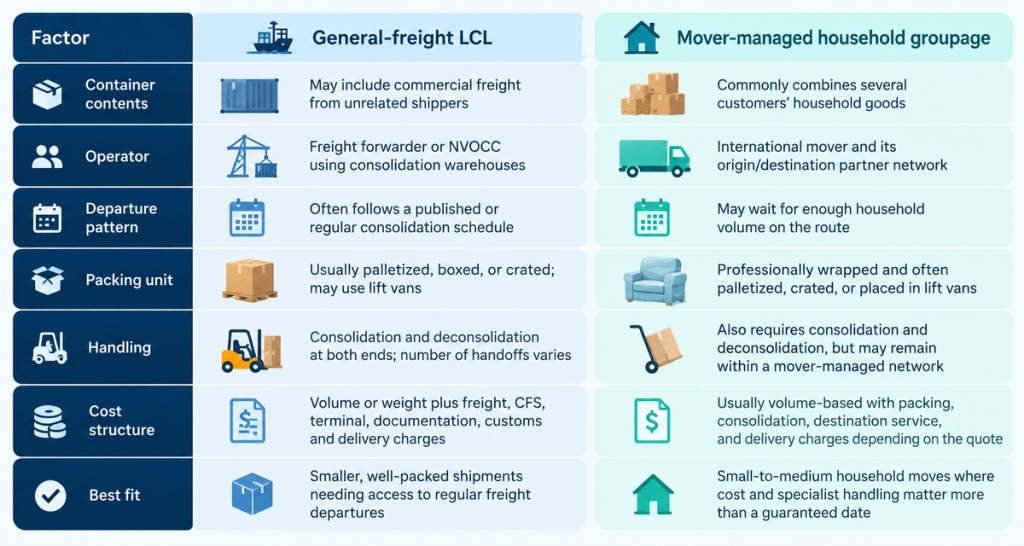
Neither model is automatically cheaper, faster, or safer in every case. Route frequency, shipment size, packing method, warehouse practices, customs readiness, destination access, and the mover’s partner network can outweigh the service name.
Cost, timing, and risk
Cost
Both services can save money compared with booking a mostly empty sole-use container because customers share the main container cost. Yet consolidated shipping has more warehouse work than a straightforward full-container move. A low rate per cubic meter can therefore be offset by collection, packing, crating, terminal handling, deconsolidation, customs clearance, delivery, and minimum-volume charges.
Compare quotes on the same service scope. A cheap port-to-port quotation should not be compared directly with a door-to-door move that includes professional packing, customs assistance, inside delivery, and unpacking.
Transit time
Separate the ocean transit from the door-to-door delivery window. The full timeline can include collection, warehouse intake, waiting for consolidation, port cutoff, sailing, transshipment, customs clearance, deconsolidation, and destination delivery.
LCL can be attractive when a forwarder has frequent fixed consolidations on your route. Groupage may take longer if the mover is still filling the container. In either case, port congestion, vessel changes, inspections, incomplete paperwork, or delayed co-loads can affect arrival. Ask for a realistic range rather than relying on an unsupported exact date.
Handling and protection
Every consolidated shipment must be combined at origin and separated at destination. The important question is whether your goods remain inside a sealed lift van or crate, or whether individual cartons and furniture pieces are handled repeatedly. Professional export packing and a clearly numbered inventory reduce avoidable risk.
Insurance also deserves close attention. The FMC notes that mover liability may be limited, marine policies can vary, and some movers will not offer broader coverage for owner-packed goods. Request the actual policy wording, valuation method, deductible, exclusions, claims deadline, and rules for self-packed cartons before booking.
Flexibility
Shared shipping is flexible in volume: you can send a few cubic meters without paying for a whole container. It is less flexible when you need a precise delivery day. If your European lease starts on a fixed date, plan temporary essentials separately and consider whether destination storage is included.
When LCL works well
LCL may be appropriate when:
- Your shipment is too large for ordinary parcel services but far below a full container.
- Your belongings can be securely boxed, palletized, or crated.
- A freight consolidator offers frequent departures to the relevant European port.
- A predictable sailing schedule matters more than having a household-goods-only container.
- The quote clearly identifies all origin and destination charges.
- You understand who handles customs clearance and final delivery.
For a very small shipment, compare LCL with international box shipping and air freight. Minimum charges and warehouse fees can make sea freight less attractive when you are sending only a few cartons.
When groupage works well
Mover-managed groupage may be preferable when:
- You are moving the contents of a studio, one-bedroom apartment, or selected rooms.
- You want professional household-goods packing and a door-to-door service.
- The mover consolidates regularly to your destination country or regional hub.
- You prefer your shipment to remain within a specialist moving network.
- You can tolerate a flexible departure or delivery window.
- The mover can explain how each customer’s goods are separated and protected.
Do not choose groupage solely because it sounds gentler or cheaper. Ask whether the container holds only household goods, whether your shipment stays in lift vans, who controls the container, and how frequently the route actually sails.
Unsuitable shared-shipping items
Some belongings should not travel in an ordinary shared household shipment, while others require advance approval and special documentation.
- Hazardous or flammable products: gasoline, propane cylinders, paint, solvents, fireworks, aerosols, and many cleaning chemicals.
- Food, plants, and soil: these can be prohibited or restricted and may trigger biosecurity or customs issues.
- Cash and essential documents: carry passports, immigration records, financial papers, jewelry, and irreplaceable small valuables with you.
- Perishables and temperature-sensitive goods: ordinary containers do not provide controlled conditions.
- Firearms, ammunition, alcohol, tobacco, and medicines: rules vary, and many movers exclude them entirely.
- Loose or damaged lithium batteries: lithium batteries are regulated hazardous materials and must meet transport, packaging, marking, and documentation rules; damaged or recalled batteries present additional restrictions.phmsa.dot+2
- Urgently needed items: medication, work equipment, children’s essentials, and anything required immediately after arrival should not depend on a flexible ocean-delivery window.
- Extremely fragile or high-value pieces: fine art, antiques, musical instruments, and heirlooms may need custom crating, specialist handling, and specific insurance approval.
Always obtain a route-specific prohibited-items list from the mover. Carrier rules, U.S. export requirements, ocean dangerous-goods rules, and destination-country restrictions can all apply.
Questions before booking
Ask each moving company the same questions so the answers and prices are genuinely comparable:
- When you say “LCL” or “groupage,” what exactly does that mean in your operation?
- Will the container carry only household goods or also commercial freight?
- Who controls the consolidation at origin and deconsolidation in Europe?
- Will my belongings be placed in sealed lift vans, crates, or pallets?
- How many times are individual items likely to be handled?
- How often does this service depart for my destination?
- Is the stated timeline port-to-port or door-to-door, and is it guaranteed or estimated?
- Is the quote based on surveyed volume, final packed volume, weight, or whichever is greater?
- What is the minimum chargeable volume, and how are overages calculated?
- Which packing, collection, port, terminal, documentation, customs, storage, and delivery charges are excluded?
- Does final delivery include stairs, elevators, long carries, shuttles, assembly, unpacking, and debris removal?
- Who is the destination agent, and who will update me after arrival?
- What customs documents must I provide, and does the service include customs-clearance assistance?
- What insurance is available for professionally packed and owner-packed goods?
- What happens if the container is delayed or my European home is not ready?
- What is your FMC license or registration status, and can I verify it independently?
Companies offering ocean transportation services for international household-goods moves from the United States must meet applicable Federal Maritime Commission requirements. The FMC advises consumers to use licensed or registered providers, obtain several written estimates, read the contract carefully, and avoid choosing on price alone. FIDI-FAIM certification is another useful quality indicator for international movers because certified companies are independently audited against industry-specific operational and supply-chain requirements.
Two moving examples
One-bedroom apartment
Consider a renter moving from Chicago to Berlin with a bed, sofa, desk, dining table, kitchenware, clothing, books, and approximately 30 boxes. The shipment is too large for parcel shipping but does not justify paying for a full container.
A shared service is the natural starting point. General-freight LCL may be attractive if it offers a clear weekly sailing, strong crating, and transparent door-to-door charges. Mover-managed groupage may be better if the customer values specialist household handling and can wait for the mover’s next Germany-bound consolidation. The right decision comes from comparing final packed volume, departure frequency, packing method, destination fees, and total door-to-door cost—not from assuming one label is always superior.
Four-bedroom household
Now consider a family moving from Texas to France with four bedrooms of furniture, living and dining rooms, appliances, outdoor items, a garage, and many cartons. A full survey may show that the shipment is large enough to use most or all of a 40-foot container. In that case, a sole-use full container should be compared with shared shipping.
A dedicated container can reduce consolidation waiting and may involve fewer handling stages, while shared shipping can still make sense if the family is taking only selected furniture or splitting the move into separate consignments. The key is actual packed volume. A bedroom count is only a starting point, especially when garages, workshops, libraries, bulky furniture, or extensive storage areas are involved.
Which option is better?
For most small or medium household moves, mover-managed groupage is often the more natural fit when careful household handling and lower total cost matter most and the customer can accept flexible timing. General-freight LCL can be a good alternative when the shipment is securely crated, the route has frequent departures, and the provider supplies a fully itemized door-to-door quotation.
The most important lesson is not to rely on terminology. Ask the provider to describe the physical journey of your belongings from your U.S. home to your European address. A strong quotation should make the packing method, container contents, schedule, partner companies, customs responsibilities, insurance, and excluded charges easy to understand.
Planning note: Shipment sizes, schedules, customs treatment, and charges vary by inventory, route, provider, season, and destination. Obtain a professional survey and written, itemized quotations before booking.
Planning a move from the USA to Europe?
Use MYEXPATGO to request moving quotes based on your origin, destination, shipment size, timing, and special items. Comparing the same details across providers makes it easier to identify the service that fits your belongings—not just the cheapest headline rate.

