
Moving Tips
How to Compare International Moving Quotes: 15 Questions to Ask Before You Choose a Mover
International moving quotes can look remarkably similar while covering very different services. Learn the 15 questions to ask before comparing the bottom-line price.
Getting three international moving quotes sounds simple.
Compare the prices. Pick the one that looks reasonable. Book the mover.
Except international moving quotes rarely work that way.
Two quotations can have completely different prices while appearing to describe the same move. One may include packing and destination delivery. Another may exclude them. One may include customs clearance. Another may list it as an additional charge. One may assume easy access to both properties, while another may leave stairs, elevators or shuttle vehicles as potential extras.
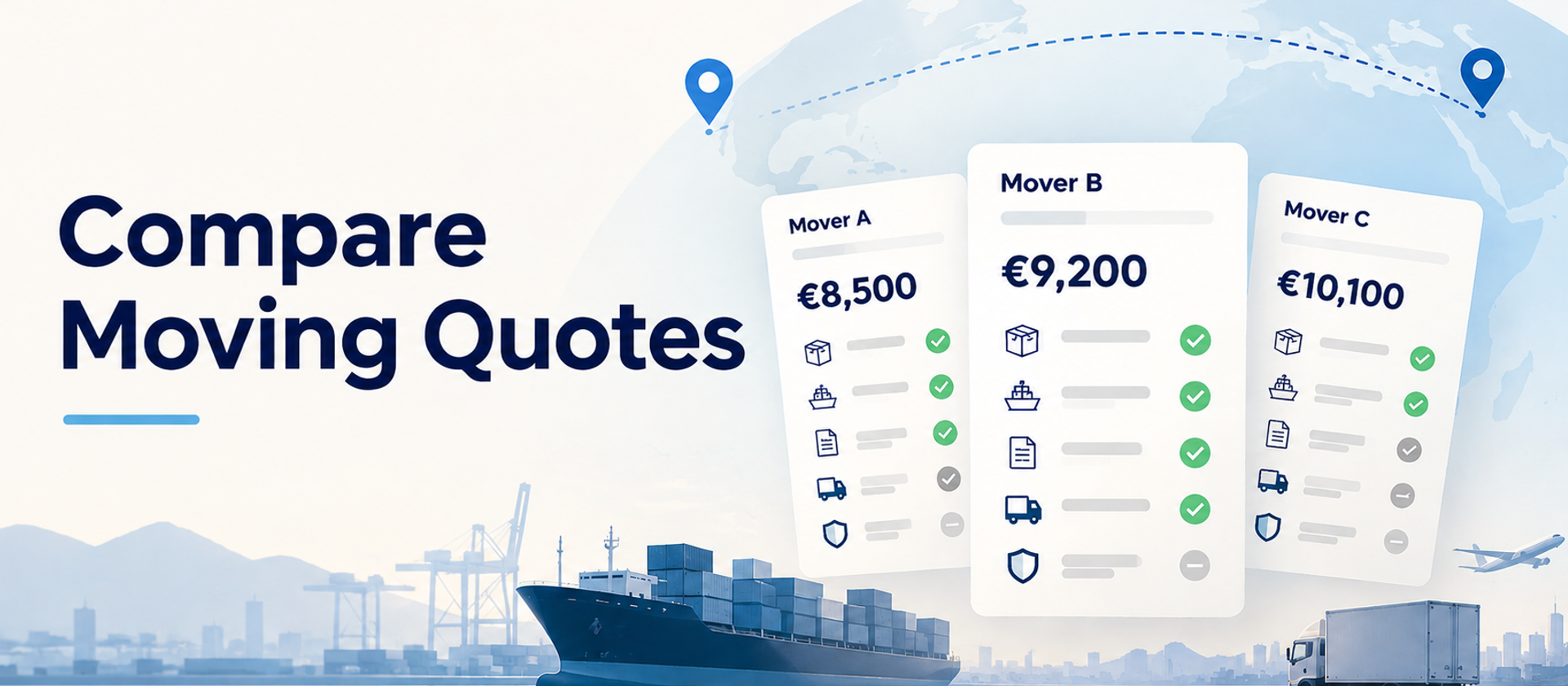
The result is a comparison that looks like this:
Mover A: €8,500
Mover B: €9,200
Mover C: €10,100
But the real comparison may be much closer to:
What exactly does each mover's price include?
That is the question that matters.
MYEXPATGO recommends comparing international moving quotes across price, scope, assumptions, conditions and exclusions — not simply the headline figure.
Here are 15 questions to ask before choosing a mover.
1. What exactly is included in the origin charges?
Start at the beginning of the journey.
Ask the mover to identify everything included at the origin address.
This might include:
- Packing
- Wrapping and protection
- Furniture dismantling
- Loading
- Collection
- Carrying goods from the property to the vehicle
- Export documentation
- Origin handling
- Transportation to the port or terminal
Do not assume that because a quotation says "origin services" or "moving services" that all of these are included.
Ask:
"Can you confirm exactly which origin services are included in the quoted price?"
If packing is excluded, find out whether the mover can provide a separate price for it.
2. Is packing and unpacking included?
Packing is one of the biggest scope differences between international moving quotations.
A quotation may include:
- Full professional packing
- Partial packing
- Fragile-only packing
- Export packing
- Customer-packed cartons
- No packing
Unpacking can be equally important.
Ask whether the quotation includes:
- Unpacking cartons
- Unwrapping furniture
- Reassembling furniture
- Removal of packing materials
Also ask whether specialist packing for artwork, antiques, electronics, mirrors or other fragile items is included or charged separately.
A lower quote that excludes packing is not necessarily a lower-cost move once the missing service is added.
3. Are destination charges included?
This is one of the most important questions in an international move.
The shipment may travel internationally, but your mover's responsibility does not necessarily end when it reaches the destination country.
Ask whether the quotation includes destination services such as:
- Port or terminal handling
- Destination documentation
- Customs clearance
- Delivery from port to residence
- Unloading
- Unpacking
- Furniture reassembly
- Removal of packing materials
A quote should make it clear where the mover's responsibility begins and ends.
4. Are customs clearance and customs-related charges included?
"Customs clearance included" can mean different things.
Ask specifically:
"Does the quotation include the mover's customs clearance service and all expected handling charges, or are any customs-related costs payable separately?"
Also ask whether government duties, taxes, inspections or other official charges are excluded.
These are not necessarily costs a mover can predict or control, so they should be clearly identified rather than buried inside a general "customs" line.
5. Are port, terminal and handling charges included?
International shipments can generate charges at ports and terminals that are easy to overlook when comparing headline prices.
Depending on the route and shipment method, ask about:
- Terminal handling
- Port charges
- Documentation fees
- Container handling
- Destination handling
- Delivery order fees
- Other local charges
You do not need to know every technical shipping term yourself.
The important thing is to ask the mover:
"Are there any origin, destination, port or terminal charges that are not included in this quotation?"
6. Does the quoted price include delivery to my actual address?
A quote for an international move is not necessarily a quote for door-to-door delivery.
Check whether the quotation includes delivery all the way to your new residence.
Then check the access assumptions.
For example:
- Is there suitable vehicle access?
- Is the property on a narrow street?
- Is there a loading restriction?
- Is there a long carry from the vehicle to the property?
- Is a shuttle vehicle required?
- Is a crane or lift required?
- Are stairs included?
- Is an elevator required?
These details can materially affect the final cost.
7. What happens if there are stairs, elevators or difficult access?
Access conditions are often treated as assumptions rather than guaranteed inclusions.
Ask the mover to state the assumptions behind the quotation.
For example:
"The quotation assumes direct vehicle access to the property."
That statement is important.
If direct access is not possible, additional handling, shuttle vehicles, waiting time or labour may apply.
Ask:
"What access assumptions does this quotation depend on, and what happens if those assumptions are not met?"
8. Is storage included?
If your move involves a gap between leaving one home and moving into another, storage can become a significant part of the relocation.
Ask whether storage is:
- Included
- Excluded
- Available at an additional cost
- Included for a specific number of days
- Charged by weight, volume, container or month
Also distinguish between storage-in-transit and longer-term or permanent storage.
These can be treated differently commercially and contractually. Industry service standards, for example, distinguish temporary storage-in-transit from permanent storage arrangements.
Ask:
"How much storage is included, for how long, and what would additional storage cost?"
9. What insurance or valuation protection is included?
Do not treat "insurance included" as the end of the conversation.
Find out exactly what protection applies.
Ask:
- What type of coverage is provided?
- Is it insurance or carrier liability/valuation protection?
- Is there a deductible?
- Are there exclusions?
- How is the value of goods determined?
- Are pairs or sets treated differently?
- Are high-value items subject to special conditions?
- Is replacement value or depreciated value used?
The wording in the quotation and contract matters.
If the mover offers additional insurance or valuation coverage, ask for the terms and price separately so you can compare them properly.
10. What volume or weight is the quotation based on?
This is particularly important when comparing multiple movers.
One mover might quote based on 15 m³, while another quotes based on 20 m³.
You cannot meaningfully compare the resulting prices without understanding the underlying shipment assumption.
Check:
- Cubic metre volume
- Weight
- Container size
- Number of cartons
- Shipment type
- Whether the volume is estimated or confirmed
- Whether the quotation is subject to remeasurement or reweighing
If your own inventory estimate differs substantially from a mover's quoted volume, that does not automatically mean either side is wrong. It means the difference should be investigated.
MYEXPATGO's Quote Intelligence model is specifically designed to surface this kind of variance rather than silently deciding which figure is correct.
11. What transit time is being assumed?
International moving quotes often contain an estimated transit time, but the number should be understood as an assumption rather than a guaranteed delivery date unless the contract explicitly says otherwise.
Ask:
"Is this transit time an estimate or a guaranteed delivery commitment?"
Then ask what could affect it.
Potential factors can include:
- Sailing schedules
- Transshipment
- Customs clearance
- Port congestion
- Documentation
- Weather
- Destination delivery availability
It is useful to distinguish between:
Estimated transit time
and
Guaranteed delivery commitment
They are not the same thing.
12. Which charges are conditional?
This is where many quote comparisons go wrong.
A quotation may contain language such as:
- "if applicable"
- "where required"
- "subject to"
- "at cost"
- "as incurred"
- "if access is restricted"
- "additional charges may apply"
These should not automatically be added to the headline price.
Instead, identify them as conditional costs.
For each one, ask:
"What specific circumstance would cause this charge to apply, and can you estimate the amount if that circumstance occurs?"
This creates a much more useful comparison.
A conditional charge is different from a known charge.
13. What is explicitly excluded?
Ask the mover to identify all exclusions.
Common examples may include:
- Packing
- Unpacking
- Customs duties or taxes
- Storage
- Special handling
- Crating
- Long carries
- Shuttle vehicles
- Hoisting
- Additional insurance
- Certain destination services
- Restricted or prohibited items
Do not simply look for a section titled "Exclusions."
Important exclusions can also appear in footnotes, terms and conditions, assumptions or individual line items.
The original quotation should remain your primary source of truth.
14. What could trigger a change order or additional invoice?
This may be the most important question of all.
Ask the mover:
"Under what circumstances could the final price increase after I accept this quotation?"
Then ask for examples.
For instance:
- Actual volume differs from the quoted volume
- Weight differs from the estimate
- Access is more difficult than assumed
- Additional packing is required
- Storage is required
- Customs inspection occurs
- Delivery requires special equipment
- The shipment specification changes
- Additional services are requested
The objective is not to eliminate every possible additional charge.
That is often impossible.
The objective is to understand which charges are known, which are conditional, and which are genuinely unknown.
15. What is the quotation validity period?
Finally, check how long the price remains valid.
International transportation costs can change, and quotations may be based on specific shipping rates, exchange rates, schedules or other commercial assumptions.
Look for:
- Quote issue date
- Expiry date
- Rate validity
- Fuel or freight assumptions
- Currency assumptions
- Conditions for price changes
Ask:
"If I accept this quotation within the validity period, which elements of the price are fixed and which can still change?"
That distinction can be more useful than simply knowing the quote's expiry date.
The biggest mistake: comparing the bottom line first
When you receive three moving quotes, it is tempting to put the prices into a spreadsheet and sort them from lowest to highest.
But international relocation is not a simple commodity purchase.
The goal is to determine the comparable scope of each quotation.
Think in three layers: quoted, known and conditional
One of the most useful ways to evaluate international moving quotes is to separate information into three categories.
1. What the mover actually quoted
This is the headline price and the specific amounts stated in the quotation.
Do not alter these figures.
2. Known additions
These are charges that the quotation explicitly identifies as additional and that can reasonably be incorporated into the comparison.
For example:
Quoted price: €8,525
Known quoted addition: €760
Comparable quoted cost: €9,285
This approach is part of MYEXPATGO's Quote Intelligence methodology: known quoted additions can be incorporated into a comparable cost, while optional, conditional and unknown charges remain separate.
3. Conditional and unknown costs
These should remain visible but should not automatically be converted into a cost.
If a mover says:
"Additional charges may apply if shuttle service is required."
That is not the same as saying:
"€450 shuttle charge."
The first is a conditional exposure.
The second is a known quoted charge.
That distinction matters.
Don't just compare price. Compare certainty.
A good moving quote comparison should answer four questions:
What am I paying?
The quoted price and known additions.
What am I getting?
The services and scope included.
What isn't included?
The exclusions and separate charges.
What could change?
The conditions, assumptions and potential additional costs.
That gives you a much clearer picture of the commercial offer than a simple price comparison.
What to ask before choosing your mover
Before accepting a quotation, make sure you can answer these 15 questions:
- What exactly is included in the origin charges?
- Is packing and unpacking included?
- Are destination charges included?
- Is customs clearance included?
- Are port and terminal charges included?
- Does delivery reach my actual address?
- What happens with stairs, elevators or difficult access?
- Is storage included?
- What insurance or valuation protection applies?
- What volume or weight is the quotation based on?
- What transit time is being assumed?
- Which charges are conditional?
- What is explicitly excluded?
- What could trigger a change order or additional invoice?
- How long is the quotation valid?
If you cannot answer these questions from the quotation, ask the mover before you compare the prices.
A better way to compare moving quotes
You shouldn't have to manually hunt through multiple PDFs to work out which services are included, which costs are conditional and which assumptions differ.
That is the problem MYEXPATGO Quote Intelligence is designed to address.
MYEXPATGO takes the information contained in mover quotations and structures it around the things that actually matter:
- Headline price
- Known additions
- Comparable quoted cost
- Services and scope
- Exclusions
- Conditional costs
- Unknowns
- Shipment specifications
- Evidence from the original quotation
- Clarification questions
The underlying principle is simple:
The quotation is the evidence. The comparison should make that evidence easier to understand.
MYEXPATGO is an independent decision-support platform. It is not a moving company, and a comparison should help you understand your options rather than simply tell you which mover to choose. The current product specification explicitly calls for evidence-backed comparison without undisclosed mover incentives or pay-to-play rankings.
Don't compare international moving quotes by headline price alone.
Compare the scope.
Compare the assumptions.
Compare the exclusions.
Compare the conditions.
And, most importantly, understand what the mover's price actually represents.
Compare your moving quotes with MYEXPATGO.
Get up to five free quotes from vetted international moving companies.

